FinTech|2022 – 2024
MeridianLink Consumer
One application from any channel, decided by rules and booked once.

Consumer
The consumer loan origination system behind every channel: apply, decide, book.

- Client
- MeridianLink
- Through
- Bhavna Software
- Role
- Mid Level Developer
Overview
MeridianLink Consumer is a cloud-based loan origination system for banks and credit unions: the system of record that takes a consumer loan application from any channel, decisions it, and hands the approved loan on. It covers personal and auto loans, HELOCs, credit cards, small business and indirect loans.
I contributed to Consumer from August 2022 to September 2024 as a software engineer at Bhavna Software India, on workflows, decisioning rules, partner integrations and the features that bring one applicant's channels together. The highlighted parts of the map are where that work sat.
Where applications start
Applicants, members, dealers and brokers
- Online (this case study)
- Mobile (this case study)
- Branch (this case study)
- Indirect (this case study)auto dealers
- Brokers and TPOs
Point of sale
The application front end
- MeridianLink Portalsucceeded by Access, Oct 2023
- Mortgage Accessmortgage point of sale
Origination
Systems of record for loans and accounts
- MeridianLink Consumer (this case study)consumer loan LOS
- MeridianLink Openingdeposit account opening
- MeridianLink Mortgagemortgage LOS, formerly LendingQB
- PriceMyLoanpricing and eligibility engine
Around it
Hundreds of partners through the MeridianLink Marketplace
- Core banking
- Credit checks
- Identity and fraud
- eSignature
- Document management
The platform in numbers
- 16M+
- auto loan applications
- 8M+
- unsecured loan applications
- 5M+
- new accounts opened
- 1M+
- home loan applications
Lifetime figures published on meridianlink.com, read October 2026. They describe the platform, not my work.
Impact
Four things that changed for lenders and underwriters. Each row names the problem, what I did about it, and which layers of the stack the work went through.
Dynamic
configurable workflows
Workflows lenders can shape
Lending teams at banks and credit unions
- The problem
- A lender's process varies by product and institution, and a fixed workflow forces staff to work around it.
- What I did
- Developed dynamic workflows in the origination system so steps follow the product and the lender's own configuration.
- UI (yes)
- API (yes)
- Data (yes)
Automated
decisioning rules
Decisions made by rules, not by hand
Underwriters
- The problem
- Applications that a rule could decide still waited in a queue for a person.
- What I did
- Developed automated decisioning rules, so qualified applications move on and underwriters spend their time on the ones that need judgement.
- UI (no)
- API (yes)
- Data (yes)
4
channels: mobile, online, branch, indirect
One application, every channel
Applicants and lenders across four channels
- The problem
- The same applicant could arrive through different channels, and the rules had to behave the same in each.
- What I did
- Built application-consolidation features across mobile, online, branch and indirect channels, so one record and one set of rules apply.
- UI (yes)
- API (yes)
- Data (yes)
Integrated
third-party services
Partners plugged into the flow
Lenders using third-party services
- The problem
- Credit, identity and other partner services have to fit the origination flow without breaking it.
- What I did
- Built third-party integrations into Consumer's workflow, inside a platform whose marketplace connects hundreds of partners.
- UI (no)
- API (yes)
- Data (yes)
Four of the four went through more than one layer of the stack. The layers come from what my resume names for this work: React and TypeScript screens, ASP.NET Core and C# APIs, and EF Core over MSSQL.
The product
A consumer loan's path through the origination system, from application to booking.
Apply
Online, mobile, in branch or through a dealer
Consolidate
One application record whatever the channel
Credit and data
Credit checks and partner data pulled in
Decision rules
Configurable rules and logic trees
Approve or review
Qualified applicants advance; the rest go to underwriting
Cross-sell
Pre-qualified products offered in the same session
Book
Loan handed to core banking through integrations
- What it is
- A cloud-based consumer loan origination system for banks and credit unions, covering personal and auto loans, HELOCs, credit cards, small business and indirect loans.
- Decisioning
- An advanced decisioning engine with configurable rules, visual logic trees and real-time data. Automated approvals move qualified applicants on at once and leave deeper review for the loans that need it.
- Channels
- A mobile-first digital application, in-branch applications, and indirect lending. MeridianLink added indirect lending capability when it acquired Teledata Communications (DecisionLender) in November 2020.
- Compliance and reporting
- Embedded controls and audit trails, fraud and identity integrations, and built-in reporting with Insight Lite and up to three years of origination data.
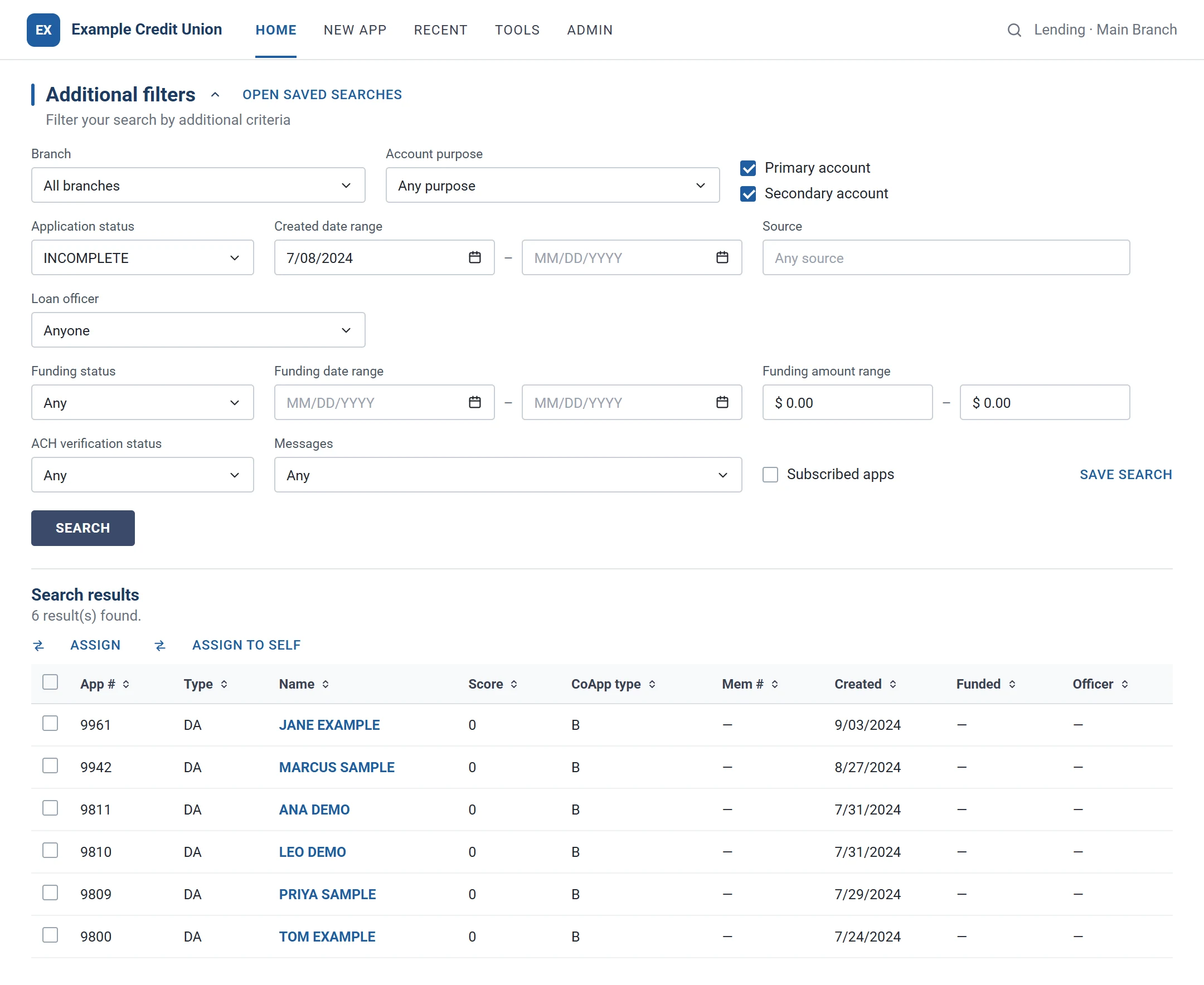
Swipe to see the whole screen.
Screens
Two screens of the lender console, drawn for this page with fictional data: the application queue and a decision on one application. Pick a callout to see which part of the screen it explains.
Screen 1 of 2
Application queue
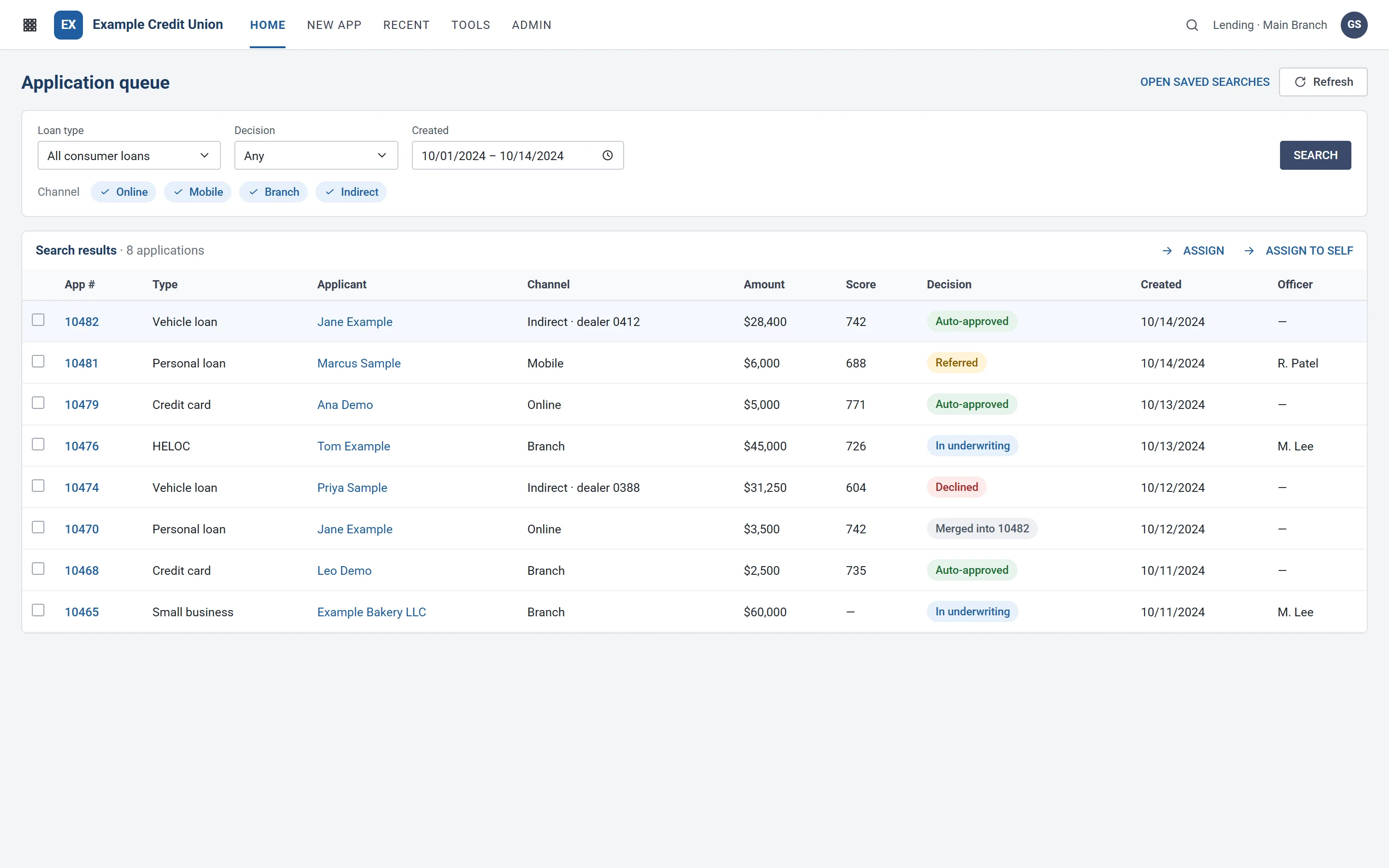
Every channel in one queue, one record per applicant.
The lender's view of incoming consumer loan applications: filtered by channel, decided by rules where possible, consolidated when the same person applies twice, and assigned to an officer when a person is needed.
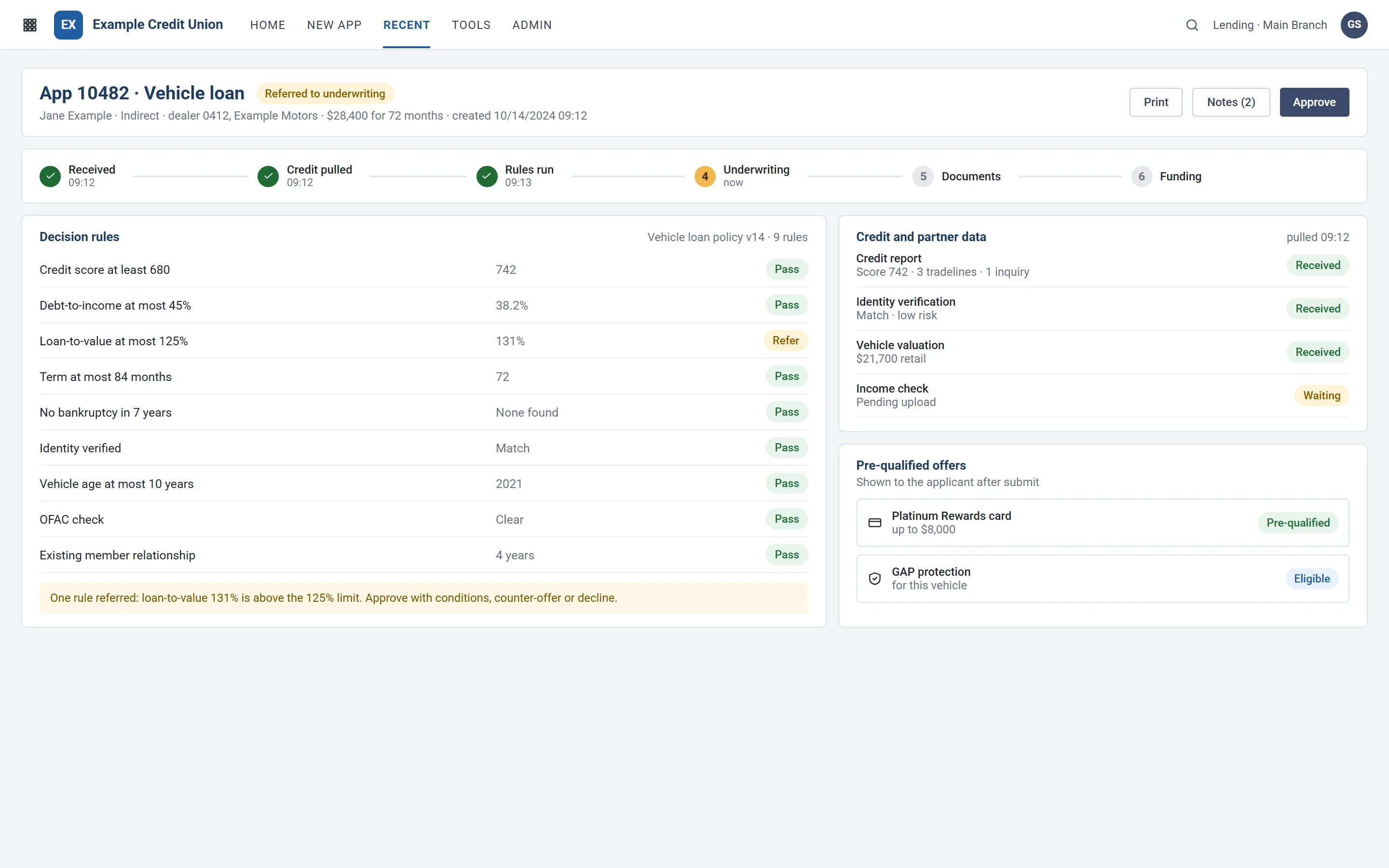
Role
- Software engineer at Bhavna Software India, on MeridianLink's products from August 2022 to September 2024.
- Created core components, and coded across HTML, CSS, JavaScript (ES6 and later), TypeScript, React, C#, VB.NET and ASP.NET Core.
- Wrote maintainable, testable code with NUnit and Moq.
- Worked with the client on requirement analysis for stories and tasks, system design, and product enhancements.
- Managed deployments and monitoring through Azure Monitor and Azure Blob Storage.
Constraints
- Consumer lending runs across mobile, online, branch and indirect channels, and decisioning rules had to behave the same in all of them.
- Lending is regulated: changes had to keep the embedded controls and audit trails intact.
- Partner services for credit, identity and fraud sit inside the flow, so an integration could never block an application.
- Legacy VB.NET and MSSQL code shared the system with newer ASP.NET Core and React work.
Architecture
Applications from every channel reach the same origination services. An ASP.NET Core and VB.NET service layer runs the workflow and decisioning rules over MSSQL, with partner integrations for credit and identity, and the approved loan moving on to core banking.
How I worked
- Straight from the client
- Requirement analysis for each story and task happened with MeridianLink directly, so system design and enhancement ideas came from the people who own the product.
- Sprint rhythm
- Feature planning, sprint discussions and peer code reviews, with work tracked in Jira and designs handed over in Figma.
- Tested as it ships
- Unit tests in NUnit with Moq for the services behind each change.
- AI assistants, used deliberately
- GitHub Copilot and ChatGPT to speed up feature work, troubleshoot issues and support code reviews.
Results
More consistent underwriting and compliance handling with faster processing across the consumer lending pipeline: workflows that follow the lender's configuration, rules that decide the routine applications, and one application record whatever the channel.
- 4
- channels on one application record
- 2
- years on the MeridianLink stack
- 1,900+
- institutions on MeridianLink by 2021
Stack
- ASP.NET Core
- C#
- VB.NET
- Web API
- EF Core
- MSSQL
- React
- TypeScript
- JavaScript (ES6+)
- NUnit + Moq
- Azure Blob Storage
- Azure Monitor
- Jira
- Figma